
VMA-DISPERGIERLEXIKON
A
Abrasion
<p>Abrasion of grinding beads from the grinding chamber and the agitator of a dispersing device can cause discoloration of the grinding paste. To prevent this, abrasion-resistant grinding beads—such as those made of zirconium dioxide, zirconium silicate, or glass beads—can be used, as they produce colorless abrasion residue. VMA Getzmann offers a range of different abrasion-resistant inner linings for dispersing machines.</p>
Absorption
<ol> <li>The dissolution of a solid or a gas in a liquid</li> <li>The absorption of energy from electromagnetic radiation (e.g., light) by a medium. The attenuation of a light beam’s intensity due to absorption is described by Lambert–Beer’s law.</li> </ol>
Absorption coefficient
<p>See Lambert-Beer’s Law</p>
Acidity
<p>Acidity (from the Latin acidus, meaning “sour”) refers to the extent to which a chemical compound can release protons (hydrogen ions) or remove electrons from another substance, as well as the general degree of acidity of a liquid.</p>
Acrylates
<p>Binders produced by the polymerization of acrylic monomers. </p>
Additive color mixing
<p>Additive color mixing is based on the use of the primary colors orange-red, leaf green, and violet-blue to produce mixed colors. The mixed color resulting from these three primary colors is white (in contrast to subtractive color mixing!). The best-known application of additive color mixing is the color television monitor. In multicolor printing, both additive and subtractive color mixing are used.</p>
Additives
<p>Additives or auxiliary agents used in the formulation of composite materials. Additives are typically used in small quantities, for example as wetting and dispersing agents, anti-settling agents, defoamers, leveling agents, UV absorbers, corrosion inhibitors, drying retarders, etc. </p>
Adhesion
<p>Synonym for adhesion. In coating technology, the adhesion of a coating to a substrate plays an important role. Empirical observations have shown that a coating exhibits good adhesion when, on the one hand, it flows well (spreads) over the substrate as a liquid and, on the other hand, has a surface energy as a solid that is similar to that of the substrate.</p>
Adhesion group
<p>Adhesion groups are the chemical building blocks of a polymer that enable it to adsorb preferentially onto solid surfaces. They are therefore also called anchor groups. These are generally groups with more or less pronounced polar or acid/base properties. They are usually identical to the functional groups used for curing coatings.</p>
Adsorbate
<p>A substance adsorbed at an interface</p>
Adsorbent
<p>A substance onto which an adsorbate is adsorbed</p>
Adsorption
<p>The attachment of one substance (adsorbate) to another substance (adsorbent)</p>
Adsorption equilibrium
<p>The distribution of an adsorbate in adsorbed and non-adsorbed forms. Adsorption equilibria are a prerequisite for chromatographic methods, for example. Adsorption-desorption equilibria also play a role in catalyst technology. In the case of pigments and fillers in liquid coating materials, adsorption equilibria of the various components form on the solid particles. (See competitive adsorption)</p>
Agglomerates
<p>According to DIN 53 206, August 1972, agglomerates consist of primary particles and smaller aggregates that are held together at edges and corners by purely physical interactions. Their surface area is, as a first approximation, the sum of the surface areas of all the smaller particles that make them up.</p>
Aggregates
<p>According to DIN 53 206, August 1972, aggregates consist of primary particles arranged in a two-dimensional manner and held together by chemical bonds. Their surface area is smaller than the sum of the surface areas of the primary particles that make them up.</p>
Aging
<p>The storage of, for example, a coating material with the aim of determining whether its properties change. Storage can also take place under accelerated conditions, such as at higher temperatures. Changes in viscosity or pigment flocculation can often be problematic.</p>
Agitator ball mills
<p>Agitated ball mills are dispersing devices in which the grinding slurry is dispersed by a rotor in a grinding vessel filled with grinding media.</p><p>Agitator ball mills can be operated either discontinuously or continuously.</p><p>In discontinuously operated agitator ball mills, the grinding slurry is fed into the grinding chamber and dispersed. In continuously operated agitator ball mills, the grinding slurry is pumped through the grinding chamber while the agitator ball mill is running. In continuous operation, a distinction can be made between the through-flow method and the recirculation method. Agitator ball mills are the most economical and efficient dispersing machines known.</p>
Air-drying paints
<p>Air-drying or “oxidative” drying coatings contain binders with unsaturated double bonds that cure through the formation of peroxides and subsequent peroxide decomposition in the presence of atmospheric oxygen.</p><p>The curing reaction is catalyzed by drying agents. Air-drying coatings (typically alkyd resins with unsaturated fatty acids) require relatively long curing times.</p>
Algaecides
<p>Additives for formulations designed to prevent algae growth. Algicides are primarily used in emulsion-based exterior paints. Organic tin compounds and copper chelates are commonly used.</p>
Aliphatic hydrocarbons
<p>Aliphatic hydrocarbons are hydrocarbons in which the carbon atoms are arranged in linear or branched chains.</p>
Alkyd resins
<p>Alkyd resins are polyester resins made from polybasic acids and diols or higher alcohols, which are modified with natural or synthetic fatty acids. Depending on the fatty acid (“oil”) content, alkydsare classified as short-oil ( <u><</u> 40% ), medium-oil ( 41 – 60 % ), and long-oil alkyds with an oil content of 61 – 70 %. Alkyd resins can be combined with many other binders.</p>
Amino resins
<p>Amino resins are reaction products of formaldehyde with substances such as urea, benzoguanamine, or melamine. Amino resins are modified through “alkylation.” Alkylation typically involves an esterification reaction between the OH groups of the amino resin and alcohols. Depending on the alcohol used (methanol and butanol are particularly common), amino resins are produced that either have a 100% solids content or contain certain amounts of solvents.<br /> <br /> Amino resins can be used in both aqueous and organic coating systems. They are always combined with other resins and serve as the hardener component for bake-curing coatings. Acrylates, alkyds, epoxy resins, or polyesters can be used as resins.<br /> <span class="small"><em>Ref.: H.J. Blank, L.J. Calbo in “Ullmann,” VCH, 5th ed. (1991), Vol. 18, pp. 414–418</em></span></p>
Anaphoresis
<p>A coating process in which the resin is present as a negatively charged polyelectrolyte in an aqueous solution, and the substrate to be coated is connected as the positive terminal of a direct current circuit. Anaphoresis resins are generally polycarboxylic acids that are reacted (“neutralized”) with amines to form water-soluble or water-dilutable polycarboxylates.</p>
Anatas
<p>A crystal form of titanium dioxide. Although anatase has poorer scattering properties and weather resistance compared to rutile, it is less abrasive, making it particularly suitable for matting synthetic fibers to protect the spinnerets. Anatase is also used in plastics and elastomers due to its low Möh’s hardness (5.5–6). In die-cut products that are cut with blades, the use of anatase results in longer tool life. Because of its self-cleaning chalking behavior, anatase is also used in road marking paints.</p>
Anti-floating agents
<p>Anti-floating agents are additives used to prevent the visible separation of pigments during storage or while a coating is drying.</p>
Anti-settling agent
<p>Also known as anti-settling agents. Due to gravity, even pigments that are well stabilized against flocculation can settle into a solid, non-resuspendable sediment (see Sedimentation). Anti-settling agents generally work by causing slight flocculation of the pigments. The settling then results in a voluminous, easily resuspendable sediment.</p>
Anti-settling agent
<p>Anti-sag agents are designed to prevent coatings from running down vertical surfaces after application. These can be, for example, very finely divided inorganic substances (e.g., bentonite, silica gel, finely divided barium sulfate) or organic additives. Anti-sag agents establish a yield point. </p>
Anti-skin agents
<p>With air-drying paints such as alkyd resins, there is often the problem that a skin forms in partially emptied containers due to a drying reaction. Anti-skin agents, such as oximes and alkylphenols, prevent this. In addition, it is always advisable to reseal opened containers airtight and to store cans, for example, with the lid facing down—"upside down."</p>
Antifouling additives
<p>Additives for boat paints designed to prevent the growth of plants, mussels, etc., on the boat’s hull.</p>
Antistatic agents
<p>Agents used to reduce the tendency of coatings or plastics to accumulate electrostatic charge. These are often ammonium compounds that bind moisture from the air and thereby reduce the electrical surface resistance.</p>
Application Methods
<p>There are various methods for applying coatings. The most common are dipping, rolling, brushing, and spraying. Dipping methods include simple dipping and electrophoretic dip coating (see ETL: Electrophoretic Dip Coating), anaphoresis, and cataphoresis. Among spraying methods, a distinction can be made between spraying with compressed air, airless spraying without compressed gas, and electrostatic spraying.</p>
B
Bag filter
<p>Filter bags made of fabric for separating undispersed material and impurities (such as fragments of grinding beads) after dispersion.</p>
Bake-on coating
<p>Coatings that require an elevated temperature to cure (activation energy of the cross-linking reaction) are called bake-curing coatings. Typical curing conditions for such systems involve curing temperatures between 120°C and 150°C and curing times between 20 min and 30 min.</p>
Ball mill
<p>Ball mills are horizontally mounted cylindrical vessels filled with grinding balls and a grinding paste, which are then set in rotational motion. They are used to grind solids or aggregates and to disperse pigments and fillers in coating materials.</p><p>Although they are technically less complex than agitator ball mills, they are also less efficient, with the result that dispersion processes are virtually no longer carried out on a production scale using ball mills in Europe.</p>
Benard cells
<p>A hexagonal, honeycomb-like surface irregularity in applied coatings caused by flow-induced segregation of pigments during flash-off. The evaporative cooling that occurs at the coating surface creates a temperature gradient between the top surface and deeper layers. This leads to ring-shaped flows, with the pigments accumulating in the slow-flowing regions at the boundaries between the Benard cells. In mixtures of pigments of different sizes, it is the coarser pigment fractions that form the boundaries of the Benard cells.</p>
BET Method
<p>Method for determining the specific surface area of a solid powder by gas adsorption according to Brunauer, Emmet, and Teller (1)<br /> <span class="small"><em>(1) S. Brunauer, P.H. Emmet, E. Teller J. Am. Chem. Soc. 60 (1938), p. 309</em></span></p>
Bimodal distribution
<p>A property that exhibits two frequency maxima is bimodally distributed. An example of this is the particle size distribution of a mixture of two pigments with different mean particle sizes.</p>
Binder
<p>The binder is the film-forming, polymeric component of a coating formulation. According to DIN 55945, plasticizers, drying agents, and other non-volatile additives are also classified as part of the binder.</p>
Binder Requirement
<p>The binder requirement of a pigment or filler is determined by adding binder solution drop by drop to a specified amount of solid powder and mixing thoroughly. The binder requirement is the amount of binder solution (relative to the pigment quantity) needed to obtain a free-flowing paste that runs off a glass rod. The determination method is analogous to that used for determining the oil number. The binder requirement number can be useful in the formulation of grinding pastes.<br /> <span class="small"><em>For more details: see “Dispersing with the DISPERMAT® Laboratory Dissolver,” VMA-GETZMANN GMBH, and DIN 55943 </em></span></p>
Binder Shock
<p>When adding a binder solution to a grinding paste during coating, the binder may precipitate if it is not readily soluble in the grinding paste formulation. The precipitated binder results in specks in the coated formulation. The binder shock can be avoided by using suitable solvents in the grinding paste.<br /> <span class="small"><em>Ref: H. Sander, Farbe + Lack 77 (1971) No. 9, p. 891 ff.</em></span></p>
Blanc fixe
<p>Term for precipitated barium sulfate (French: “permanent white”)</p>
Blocking resistance
Various workpieces should be stackable shortly after coating without the parts sticking to one another. The property of having as little tendency to stick as possible is called block resistance.
Blue paste method
<p>Method for determining the light-scattering ability of white pigments</p>
Bulk density
<p>The bulk density of a pigment or filler is the mass of a given quantity of pigment divided by its bulk volume. Knowing the bulk density is important for planning inventory management in paint factories.</p>
Bulk volume
<p>The bulk volume of a pigment or filler is the volume of the particles plus the voids between the particles when the material is loosely packed.</p>
C
C. I.
<p>The "Color Index" is a list of commercial pigments and fillers, organized according to their basic chemical structure.</p>
Capillary viscometer
<p>A device for determining the kinematic viscosity of polymer solutions based on the flow time through a capillary (e.g., Ubbelohde viscometer). Capillary viscometers are not commonly used for coating materials. Flow cups, on the other hand, can be regarded as capillary viscometers with a short capillary length.</p>
Carbon blacks
<p>Carbon blacks are black pigments consisting of carbon. Depending on the manufacturing process, a distinction is made between types that differ in their average particle diameters.</p><h3>Acetylene carbon blacks (25 nm – 45 nm)<br /> flame carbon blacks (50 nm – 120 nm)<br /> gas carbon blacks (10 nm – 30 nm)<br /> furnace carbon blacks (13 nm – 80 nm)<br /> thermal carbon blacks (120 nm – 150 nm)</h3><p>Some types with a high graphite content exhibit sufficient electrical conductivity to be used as conductive pigments.</p>
Cascade process
<p>A dispersion process in which the ground paste passes through a series of disperse units connected in series (e.g., agitated ball mills). The advantages of this process configuration lie in the ability to use grinding beads of different sizes in the individual cascade stages and in the standardization of the residence time distribution (see Residence Time)</p>
Cataphoretic coatings
<p>A coating process in which the resin is present as a positively charged polyelectrolyte in an aqueous solution and the part to be coated is connected as the negative terminal of a direct current. Cataphoresis resins are generally polymers containing ammonium groups that are reacted with organic carboxylic acids to form polyammonium compounds.</p>
Chalking
<p>Chalking refers to the detachment of pigment particles from the coating as a result of binder degradation caused by artificial or natural weathering (UV light and moisture exposure). Some pigments are themselves photochemically active and cause the binder to degrade around them. Such pigments promote chalking.</p>
Channel carbon black
<p>Gas-phase carbon blacks produced by the channel process. To produce them, natural gas is thermally decomposed, and the resulting surface-rich, colloidal carbon black—with a rugged, porous, acidic surface—is deposited in so-called “channels” made of iron. Dispersing these carbon blacks is not entirely straightforward due to their fine particle size (see Gas-phase carbon blacks)</p>
Clear coat
<p>An unpigmented, transparent coating system with no hiding power, whose color is derived solely from the binder itself.</p>
Coagulation
<p>The aggregation and associated precipitation of colloidal particles is called coagulation. The specific case of coagulation involving pigments or fillers is described by the term flocculation.</p>
Coating
<p>After a grinding paste has been dispersed, the formulation is completed into a liquid coating material by adding further liquid formulation components. This process is called “coating” (see Completion)</p>
Coating throughput
<p>The mass or volume of grinding paste that flows through a continuously operated dispersing device per unit of time. Depending on the context, the coating throughput is also linked to the dispersion state of the grinding paste, e.g., when describing the performance of a dispersing machine.</p>
Coil Coating
<p>A coating process in which metal strips (coils) are coated in large-scale facilities (coil coating), whereby parts can later be punched out of the coated metal strips and formed into the finished, coated workpiece—such as food cans. Metallic facade elements, for example, are also coated in this manner.</p>
Colloidal solution
<p>Colloidal solutions—unlike true solutions—are suspensions of colloidal particles (see colloids) in liquids, with a phase interface existing between the colloids and the liquid (“carrier liquid”). According to this definition, both emulsions (see Emulsion) and dispersed pigment and filler particles are colloidal solutions.</p><p>Sometimes a distinction is made between lyophobic (see Lyophobic) and lyophilic (see Lyophilic) colloids. Lyophobic colloids form colloidal solutions (e.g., pigments in a binder solution), while lyophilic colloids form true solutions (e.g., polymers in a thermodynamically suitable solvent).</p>
Colloids
<p>In practical terms, all particles ranging in size from10⁻³ µm to 1 µmcan be considered colloids. A common feature of all colloids is that they have relatively high specific surface areas and that their properties in colloidal solutions (see there) depend largely on their chemical surface properties.</p>
Color depth
<p>Color depth is a measure of the intensity or saturation of a color perception. Colors with the same color depth appear as if they were produced with colorants of equal color strength.</p>
Color measurement instruments
<p>Colorimeters are instruments that can illuminate (or transmit light through) an object or material with defined wavelengths of light and measure the reflected (or transmitted) radiation intensity.</p><p>A distinction is made between tristimulus devices and spectrophotometers. With tristimulus devices, color measurement is performed using standardized color filters (see standard spectral value functions) for red, green, and blue to calculate the standard color values X, Y, and Z.</p><p>Spectrophotometers are instruments that measure radiation at specific wavelengths instead of using the standardized red, green, and blue color filters. In the latter case, the spectral reflectance curve is obtained, which, with the help of the irradiance function of the illuminating radiation and the standard spectral value functions for red, green, and blue, also yields the standard color values X, Y, and Z.</p>
Color strength
<p>Color strength is a measure of a colorant’s ability to impart color to other substances based on its absorptive capacity (DIN 55986 / April 1981). The color strength of a colored pigment is determined when mixed with a white pigment and is defined as the ratio K/S, where K is the absorption coefficient and S is the scattering coefficient.</p><p>Color strength is determined from the reflectance measured at the absorption maximum. The color strength depends on the dispersion state of the pigments and increases with progressively better distribution up to a system-dependent limit. The dispersion process can therefore be monitored by measuring color strength (DIN 53238, Part 22).</p>
Colorants
<p>Colorant is the general term for all color-imparting substances. According to DIN 55944, colorants are classified into organic and inorganic colorants, which are further subdivided into natural and synthetic types. A further distinction is made between pigments and dyes.</p>
Colorimetry
<p>Colorimetry is the science concerned with the measurement and quantification of color. Colorimeters are used to measure the reflectance values responsible for color. From these reflectance values, the color values—the standard color values X, Y, and Z—can be determined based on the standard color space.</p><p>Through a mathematical calculation, these are converted into the standard color value components x, y, and z, which quantify the color.</p><p>An alternative method of quantification involves specifying x, y, and Y. Y, the standard color value for the green filter, is also called the light reference value. Another method of quantification involves specifying color saturation and lightness. The relationships are summarized in DIN 5033, Parts 1–9.</p><p>Further quantification of color is possible using the L*, a*, b* color space (CIE 1976). The relationships are described in DIN 6174. L* represents perceived brightness, a* represents the position on a green/red axis, and b* represents the position on a blue/yellow axis. The L*, a*, and b* axes form a rectangular coordinate system.</p>
Competitive adsorption
<p>Competitive adsorption of various adsorbable substances onto the surface of pigments and fillers. Competitive adsorption can be partially ruled out by first placing the pigment only in a solution of the component (e.g., wetting agent) that is to be adsorbed. In polymer solutions with a broad molecular weight distribution, low-molecular-weight components are preferentially adsorbed rapidly (kinetically controlled adsorption).</p><p>At thermodynamic equilibrium after a longer period of time, higher-molecular-weight molecules are preferentially adsorbed to the surfaces (thermodynamically controlled adsorption). The reason for this is that the desorption of a molecule is only complete once it has detached from all binding groups. This occurs more easily with low-molecular-weight substances.</p>
Conductive pigments
<p>Conductive pigments are pigments with a certain degree of electrical conductivity that are used to impart antistatic properties to coatings. In addition to so-called conductive carbon blacks, pigmentary semiconductors such as antimony-doped tin dioxide, potassium titanate, or aluminum-doped tin oxide are used.</p><p>Other types consist of ordinary pigments that have been surface-treated with a semiconductor layer. The antistatic effect—that is, the electrical conductivity of such systems—is based on the formation of conductive pathways between pigment particles that come into contact with one another.</p>
Conformation
<p>The conformation of a molecule is the spatial arrangement of atoms or groups of atoms, which can result from rotation about single bonds between neighboring atoms. Dissolved linear polymers form ellipsoids that are more or less highly entangled. Upon adsorption onto solid surfaces, the conformation changes through the formation of loops, trains, and tails.</p>
Consistency
<p>Verbal description of the consistency of a suspension, e.g., thick (“thick”), easily flowing (“smooth”), thin (“thin”), creamy, etc.</p>
Contact angle
<p>When a drop of liquid is placed on a surface on which the liquid does not spread (see Spreading), a contact angle can be measured between the base of the drop and the substrate. (See Wetting). Microscopic equipment is used for this purpose.</p><p>A distinction is made between the advancing contact angle, which is measurable when more liquid is added to the drop, and the receding contact angle, which is measurable when liquid is removed from the drop via a fine needle.</p><p>The difference between these two angles is called hysteresis. One reason for the occurrence of hysteresis can be substrate roughness. Furthermore, as the drop shrinks, residual liquid molecules on the substrate exert a spreading pressure that reduces the contact angle.</p>
Containers
<p>Term for storage or delivery containers for coating materials</p>
Contrast board
<p>A cardboard panel with at least one black and one white area for determining the contrast ratio or the opacity of a coating.</p>
Contrast ratio
<p>The contrast ratio (KV) is a measure of the transparency or opacity of a coating and is calculated by measuring the remission using a green filter over a black area (Rs) and a white area (Rw) according to the following formula</p><h3>KV = Rs/Rw × 100</h3><p>This formula expresses the contrast ratio as the percentage of remission over the black area relative to the remission over the white area. The smaller the KV value, the more transparent the coating.</p>
Corrosion inhibitors
<p>Additives designed to prevent corrosion of metal containers or, in aqueous systems, corrosion of metal parts of the substrate before the coating has fully dried.</p>
Corrosion-protective pigments
<p>Pigments designed to protect metallic substrates from corrosion. A distinction is made between active corrosion-protective pigments (lead minium, lead chromate, strontium chromate), which intervene in the redox reactions of the corrosion process, from pigments that are effective only under certain formulation conditions (e.g., zinc phosphates) or that protect against corrosion through a barrier effect (e.g., mica).</p>
Craters
<p>A defect in a coating caused by an air bubble or a flow irregularity. Possible causes of flow irregularities include pinpoint elevations on the coated substrate, foreign particles in the coating (lint), or surface contamination of the substrate, such as grease droplets or silicone oil droplets.</p>
Critical PVK
<p>The PVK at which there is insufficient binder to coat all pigment particles. At the critical PVK, a number of coating properties (e.g., mechanical parameters, gas permeability, colorimetry (see dry hiding effect)) change abruptly.</p>
Critical surface tension
<p>The critical surface tension is the surface tension of the liquid that is currently spreading on the substrate surface. It is determined by a Zisman test (See Wetting + Young–Dupre equation)</p>
Cross-cut test
<p>A method for determining the adhesion of coatings in accordance with DIN ISO 2409, in which a cross-shaped grid pattern is scored into the coating using a scoring knife, and the resulting delamination is assessed visually.</p>
D
DD – Paint
Trade name of Bayer AG for two-component polyurethane coatings consisting of an isocyanate-containing resin (Desmoder) and a hydroxyl-containing resin (Desmophen)
Deaeration
<p>During dispersion, air in the form of small bubbles can be stirred into the grinding paste. This air can lead to pinholes or craters during the application of coatings. Therefore, grinding pastes are deaerated as needed. The most common methods are applying a vacuum (see vacuum dissolver) and degassing via three-roll dispersion. In many cases, however, passing the grinding paste through a sieve or filter is also effective. If foaming occurs, the use of a defoamer can help.</p>
Defoamer
<p>Defoamers are surfactants that interact with the liquid-gas interface and increase the interfacial tension there. As a result, foam lamellae on the coating surface burst, while the gas bubbles inside the coating should coalesce into larger bubbles with a smaller total surface area, allowing them to rise to the surface more easily. These are often silicones, while mineral oils are also used in aqueous systems. The destabilizing effect on foam lamellae is oftenenhancedby fine-particle solids such asSiO₂, metal stearates, etc.</p>
Deionized water
When water contaminated with salts is passed through ion exchangers (cation exchangers and anion exchangers), the dissolved cations (mostly alkali and alkaline earth ions) are exchanged for protons, while the anions are exchanged for hydroxyl ions. For many technical purposes, only the cations are undesirable, and these are removed by a cation exchanger. In this case, the water is referred to as “partially demineralized water,” whereas completely deionized water is technically designated as “fully demineralized” (VE water).
Dilants that affect flow behavior
<p>Dilatant flow behavior (= dilatancy) refers to the rheological behavior in which a liquid responds to an increasing shear rate with a disproportionately large increase in shear stress and thus in viscosity. A well-known example is bread dough. However, grinding pastes rich in solids also exhibit this property, which is advantageous—in moderation—for dispersions produced using a dissolver. Grinding pastes intended for processing with shaking devices or agitator ball mills, on the other hand, must not exhibit dilatant flow behavior.</p>
Dipole moment
<p>In the coatings industry, the term “dipole moment” generally refers to the electric dipole moment.Molecules that exhibit an asymmetric distribution of charge possess a dipole moment due to a. differences in the electronegativity of the atoms (permanent dipole moment) or b. differences in polarizability, i.e., the ability of charges to shift when placed in an electric field (induced dipole moment). Dipole moments determine the polar character of molecules.</p>
Dispersing aids
<p>Dispersing aids are additives in paint and coating formulations that tend to adhere to the surfaces of pigments and fillers. In this way, they promote the wetting of the solids.</p><p>Dispersing aids can be oligomeric or macromolecular. In any case, they should have functional groups with high affinity for the pigment surface and exhibit moderate solubility in the binder solutions used.</p>
Dispersion
<p>The process by which gases, liquids, or solids are finely distributed in a continuous liquid phase is referred to as dispersion. Unlike solutions, systems produced by dispersion share the common feature that a phase interface between the dispersed gas, liquid, or solid and the continuous liquid phase is maintained. In coating technology (DIN 55943), dispersion is generally understood to mean the breaking down of agglomerates into smaller agglomerates, aggregates, and primary particles. During dispersion, the solid surface is wetted by liquid components of the grinding paste formulation (see “Wetting”), and the resulting smaller particles are distributed homogeneously throughout the dispersion medium.<br /> <br /> It is generally desirable for these particles to be stabilized against flocculation. Dispersion can therefore be conceptually broken down into the following substeps:<br /> a. Wetting of the solid surface<br /> b. Mechanical fragmentation of the agglomerates, and<br /> c. Stabilization of smaller agglomerates, aggregates, and primary particles against flocculation .</p>
Dispersion hardness
<p>According to DIN 53238, dispersion hardness is defined as the percentage increase in color strength between two arbitrarily defined dispersion stages. Since color strength is usually determined as a function of dispersion time, it serves as a measure of the increase in color strength that can be achieved through prolonged dispersion. The general definition equation is:</p><h3>D = 100 × ( (F2/F1) – 1 )</h3><p>where<br /> D = dispersion hardness,<br /> F1 = color strength of the ground paste after time t1, and<br /> F2 is the color strength after time t2 ( t2 > t1 )</p><p>Based on fundamental relationships, it follows that the dispersion hardness is meaningful only under precisely defined conditions (grinding paste formulation, dispersing equipment, duration, etc.). Since the absolute value of the color strength is not included in the equation, specifying only D can lead to a misleading result in cases where a pigment is almost impossible to disperse. The dispersion hardness must be distinguished from the intrinsic hardness.</p>
Dispersion paint
<p>Water-dilutable paint in which the binder was produced by emulsion polymerization and is thus present as latex surrounded by a protective colloid. With higher pigment content, emulsion paints are used as interior wall paints. With lower pigment content (glossy emulsions), they are also suitable as exterior paints, which must have a certain degree of weather resistance.</p><p>For exterior applications, emulsion paints are formulated with algaecides; the combination of organometallic algaecides (short-term effect) with lithopone (long-term effect) has proven particularly effective in preventing algae growth. In recent years, conventional pure acrylate and styrene/acrylate dispersions have been supplemented by polyurethane dispersions from various manufacturers.</p>
Dissolver
<p>A dispersing device consisting of a stirring shaft with a toothed disc attached to its end. VMA Getzmann manufactures a wide range of different models. The use of the DISPERMAT® laboratory dissolver is described in the brochure “Dispersing with the DISPERMAT® Laboratory Dissolver (VMA-GETZMANN GMBH).”</p>
DLVO theory
<p>Independently of one another, Darjaguin and Lanau (Russia) and Verwey and Overbeek (Netherlands) developed a theory in the 1930s and 1940s regarding the electrostatic stabilization of colloidal particles in aqueous suspensions. The theory was named DLVO after these researchers. The basic principles of the DLVO theory involve taking into account the attractive van der Waals force and the repulsive force caused by like-charged electrostatic charges on the particles. If the repulsive force predominates at any particle distance, the particles are stable against flocculation.</p>
Doughnut effect
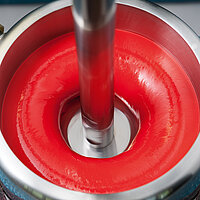
<p>Appearance of the ground paste during dispersion with a dissolver when the ground paste has good rheological properties and the dissolver disc is operating at optimal rotational speed and thus circumferential velocity. (See Dissolver)</p>
Dry hiding effect
<p>A compound term derived from the English words “dry” and “hiding.” For light-scattering pigments (see Mie theory), the hiding power depends, on the one hand, on the particle size relative to the wavelength of the incident light and, on the other hand, on the relative refractive index—the ratio of the pigment’s refractive index to that of the medium. This ratio increases sharply at the critical PVK (pigment volume concentration), with the light-scattering effect also increasing accordingly.</p><p>Dispersion paints for interior applications (wall paints) are often pigmented beyond the critical level, so that even fillers that scatter very little light in the liquid paint contribute to the light-scattering ability in the dried film. This is referred to as the “dry hiding effect.”</p>
Dyes
<p>Dyes are colorants that are soluble in the application system.</p>
Dynamic viscosity
<p>Derivation: Let two plates of area A be arranged parallel to each other at a distance h. Between the plates is a fluid with Newtonian flow behavior. One of the plates is pulled with a force K (as shown in the figure) so that it moves at a velocity v. Then K/A is proportional to v/h. The ratio K/A is called the shear stress, and v/h is called the shear rate (D).</p><p>The proportionality constant is the dynamic viscosity η.</p><p>Dynamic viscosity is a measure of the internal friction or “viscosity” of a fluid.</p>
E
Edge alignment
<p>When surface tension is high or liquid coatings have poor wetting properties on the substrate, so-called edge bleeding of the coating occurs, in which the substrate edges remain covered only by a thin layer of coating or remain completely uncoated.</p>
Effect pigments
<p>Pigments that exhibit color behavior dependent on the angle of illumination and observation. Examples include metallic pigments (see metallic-effect coatings) and pearlescent pigments.</p>
Electrophoretic mobility
<p>The migration velocity of an electrically charged particle in a suspension to which an electric field is applied. Electrophoretic mobility is expressed as velocity per unit of applied field strength. (See also microelectrophoresis, electrostatic double layer, electrostatic repulsion, stabilization, DLVO theory, zeta potential)</p>
Electrostatic double layer
<p>A term from the theory of electrostatic stabilization of colloidal particles (see DLVO theory). Colloidal particles can acquire a surface charge through various mechanisms:</p><p>a. Dissociation of surface-bound groups<br /> b. Adsorption of ions from the solution<br /> c. Adsorption of polyelectrolytes from the solution</p><p>The charge carriers located directly on the particle surface as a result of these processes are called the potential-determining ions. They determine the direction of migration of the colloidal particles in a DC electric field. It is assumed that these charge carriers are very firmly adsorbed even in cases b. and c. and therefore do not detach even in a flowing environment. This is referred to as the inner part of the electrostatic double layer. Adjacent to this is a region in which ions primarily oppositely charged to the potential-determining ions are present.</p><p>This is the outer part of the double layer, which extends to the electroneutral solution—that is, a solution containing an equal number of positive and negative ions.</p>
Electrostatic painting
<p>A coating process in which electrostatically charged paint mist droplets are applied to an object to be coated that has an opposite charge.</p><p>A distinction can be made between processes in which the atomization of the liquid paint is due solely to electrostatic charging and those in which atomization is caused or assisted by mechanical action. The main advantage of electrostatic painting methods lies in the directed nature of the spray flow toward the object, which results in less overspray and produces glossy coatings.</p>
Electrostatic Powder Coating
<p>Powder coatings are applied either electrostatically or by briefly dipping a preheated object into a fluidized bed of powder coating. In electrostatic powder coating, the powder is charged with the opposite charge to that of the object to be coated. The powder coating acquires a positive charge through turboelectric charging on polytetrafluoroethylene. Common systems involve charging the powder coating negatively via corona discharge (see Corona Process).</p><p>After application of the powder coatings, heat treatment (see Baked Coating) is always performed to cure the coating.</p>
Electrostatic repulsion
<p>Colloidal particles that are surrounded by an electrostatic double layer and have the same charge (same sign) are subject to an electrostatic repulsive force. In organic and aqueous systems, electrostatic repulsion can play a decisive role in stabilizing the particles against flocculation (see Coulomb forces).</p>
Emulsifiers
<p>Water and oily liquids are not miscible with each other, or only to a very limited extent. However, by adding substances consisting of rod-shaped molecules with one hydrophilic and one hydrophobic end, emulsions of oil droplets in water or water droplets in oils can be produced. Such substances are called emulsifiers.</p><p>Examples of emulsifiers include the sodium salt of paratoluene sulfonic acid and the sodium salt of lauryl sulfate. Emulsifiers are also suitable as raw materials for detergents, since dirt typically contains fat-like components that become “water-soluble” when emulsified (see protective colloid).</p>
Emulsion
<p>A mixture of liquid components that are immiscible, in which one component is dispersed in the other in the form of very fine droplets or particles, is called an emulsion. Emulsions tend to undergo phase separation—that is, separation—if they are not stabilized by emulsifiers.</p>
Emulsion polymerization
<p>Polymerization process for the production of latex. In emulsion polymerization, the monomers are introduced into water together with an emulsifier and an initiator for radical polymerization. The emulsifier forms micelles in which the monomer molecules accumulate by diffusing from the monomer droplets through the aqueous phase.</p><p>Within these micelles, radical polymerization is triggered by the decomposition of the initiator upon heating. The end result of emulsion polymerization is the formation of extremely fine polymer spheres (latex) that are coated with emulsifier (“protective colloid”) and serve as the binder base for emulsion paints.</p>
Energy input
<p>Unfortunately, the term “energy input” into a dispersing device is used in many different ways. It is often associated with power consumption. In dispersing processes, however, the decisive factor from an energetic standpoint is the mechanical power acting on the grinding paste. Physically speaking, energy is the ability to perform work. Energy can therefore be converted into work. Energy and work are expressed in terms of force multiplied by distance. The physical concept of power is derived from these quantities, “energy” and “work.” Power is defined as work per unit of time (this is very intuitive, since the one who accomplishes the most work in the least amount of time is said to be the most powerful). During dispersion, energy E is introduced into the grinding chamber, for example, in the form of stirring power P. The following equation applies:</p><h3>P = E / t</h3><p>where t = a unit of time.</p><p>Experimentally, it has been found that the success of dispersion (e.g., the gloss of a coating made from the ground paste or the color intensity of the ground paste itself) depends directly on the magnitude of the stirring power and thus on the energy E continuously introduced. </p><p>This fact has led to the patented power-controlled bead mills from VMA-GETZMANN GMBH. One parameter that is often mistakenly regarded as the energy input relevant to dispersion success is the dispersion work. The dispersion work A is the total work or energy input during the dispersion time</p><h3>d A = P × d = E / t × d</h3><p>The dispersion work is directly related to dispersion success only at very high energy inputs E, i.e., when the dispersion duration—rather than the stirring power—is the limiting factor, is directly related to the success of the dispersion.</p>
Epoxy resins
<p>Epoxy resins are synthetic polymers that contain epoxy groups as structural units and functional groups participating in the curing reaction. A distinction is made between bisphenol A resins, which are produced by the reaction of bisphenol A with epichlorohydrin, and bisphenol F resins, which are synthesized from bisphenol F and epichlorohydrin. In addition, heterocyclic epoxy resins (tricyclohexyl isocyanurate) are of technical importance as binders for powder coatings. Epoxy resins can be cured with polyamines, thiols, isocyanates, amino resins, etc.<br /> <span class="small"><em>Ref.: H. Gempeler, W. Schneider in ‘Ullmann’, 5th ed., VCH (1991), Vol. 18, pp. 407–414</em></span></p>
Erichsen indentation
<p>A DIN-standardized method (DIN 53156) for testing the elasticity and adhesion of a coating on metallic substrates, in which the paint surface is examined under a microscope while a spherical body deforms the sheet metal from behind. The indentation value is recorded as the penetration depth of the mandrel at which cracks in the paint become visible.</p>
ETL
<p>Abbreviation for electrodip coating. In ETL processes, aqueous solutions of ionic polymers are used as binders. These polymers carry an electrostatic charge and therefore migrate in a direct current electric field toward the electrode with the opposite charge. In ETL processes, the metal workpiece to be coated serves as this electrode. The polymer deposits there and can later be cured by baking. (See anaphoresis and cataphoresis).</p>
Evaporation rate
<p>The evaporation number according to DIN 53170 is a measure of the volatility of solvents. It is defined as the ratio of the evaporation time of a given quantity of a solvent to the evaporation time of an equal quantity of diethyl ether.</p>
F
Fillers
<p>Powdered solids that are added to coating formulations to achieve specific application-related properties (e.g., application properties, flow behavior, mechanical properties) or for cost reasons (extenders). Fillers differ from pigments in that they are not used for the purpose of coloring.</p>
Film-forming device
<p>A device that allows a film-spreading squeegee (see squeegee) to be guided at defined speeds over a flat substrate to be coated. To prevent lighter substrates (e.g., contrast cardboard) from slipping, they can be held in place by vacuum suction.</p>
Flash point
<p>The temperature at which a flammable gas mixture forms above a liquid.</p>
Flash-off
<p>Allowing an applied coating to stand before baking to ensure that the majority of the solvent has evaporated.</p>
Floating
<p>The visible segregation of pigments in a coating during storage or drying.</p>
Flocculation
<p>Flockulation refers to the mutual aggregation of colloidal particles, resulting in the formation of more or less loosely packed flocculates. Particle flocculation occurs when, at a certain distance between the particles, the attractive forces (van der Waals force, Coulomb force due to opposite electrostatic charges, magnetic force) outweigh the repulsive forces that stabilize the particles (Coulomb force due to like charges, steric stabilization by adsorbed polymers).</p>
Flockulates
<p>Aggregations of particles formed from a suspension through flocculation, which often exhibit ribbon- or web-like structures, are referred to as flocculates.</p>
Flow behavior
<p>Various terms are used to describe the flow behavior of liquids and solid suspensions. Liquids in which the dynamic viscosity is independent of the shear rate are called Newtonian liquids. If a Newtonian fluid has a yield point, it is referred to as a Bingham fluid.</p><p>If the dynamic viscosity increases with increasing shear rate, this is called dilatancy or dilatant flow behavior. Furthermore, the flow behavior can also depend on the duration of shearing: If the dynamic viscosity decreases with prolonged shearing, this is known as thixotropy (thixotropic flow behavior). If, on the other hand, it increases, the fluid is referred to as a rheopex (rheopexy).</p>
Flow Cup
<p>Standardized device for determining the flow time of a liquid coating material as a measure of kinematic viscosity. The flow cup consists of a vessel that tapers conically downward and has a spout (ISO 53224, July 1973)</p>
Flow curve
<p>When adding a binder solution to a predetermined amount of pigment or filler, the pour point (according to Daniel) is reached when the mixed paste flows freely off a glass rod and one or two drops finally detach from the rod. A method for optimizing grinding pastes is based on determining the flow point for binder solutions of graded concentrations.<br /> <span class="small"><em>Ref. W. Liehr, Farbe + Lack 71 (1965) 625</em></span></p>
Ford cup
<p>Beaker for determining the flow time according to ASTM Standard D 1200 See Flow Cup</p>
Formulation
<p>Coating formulations list the weights of all individual components of the uncured coatings. They are usually standardized to 100 or 1,000 parts by weight of the total formulation. Depending on the number and composition of the individual components—which may themselves be mixtures—formulation calculations can be very complex.</p><p>A computer program called Formula 1 from VMA-GETZMANN GMBH provides a solution here, allowing formulations to be converted, for example, based on criteria such as:</p><ul> <li>total mass,</li> <li>PVK of one or more components,</li> <li>ratios of binders to one another, etc.</li> </ul><p>The integration of a comprehensive raw material database is very helpful, as it eliminates the tedious task of looking up raw material data.</p>
Free radical scavenger
<p>Radical scavengers are substances that improve the weather resistance of coatings by deactivating photochemically induced radicals. Chemically, they are sterically hindered amines (HALS = Hindered Amine Light Stabilizers) that contain a tetramethylpiperidine group as their active group.</p><p>During its reaction with radicals,the nitrogen atom of the piperidine ring is oxidizedto the nitroxyl radical (N-O· ), which keeps the concentration of harmful peroxide radicals low.<br /> <span class="small"><em>Ref.: A. Valet, M. Slongo in Ullmann, 5th edition, Volume 18, p. 471</em></span></p>
Fungicides
<p>Additives that prevent fungal growth on coatings.</p>
G
Glass transition temperature
<p>A temperature below the solidification point of (cross-linked) polymers; when this temperature is exceeded, the polymer remains in the solid state, but individual chain segments become mobile. The glass transition temperature is very important with regard to the physical properties of coatings, such as hardness, elasticity, permeability, and adhesion.</p>
Gloss measurement
<p>A method for determining the reflective scattering of light from a surface compared to a standard black glass surface. As the dispersion of pigments and fillers improves, the gloss of a coating increases.</p>
Grain size distribution
<p>The particle size distribution indicates the frequency with which particles of a given diameter class are represented in the particle ensemble. Graphically, this is represented either by the cumulative curve of the diameter distribution (cumulative frequency of the diameter distribution) or by the differentiated cumulative curve, the actual distribution curve.</p><p>For pigments and fillers, the particle size distribution can often be described by a logarithmic normal distribution. In sieve analyses of large particles (e.g., sand, etc.) or agglomerated pigment and filler powders, the diameter distribution can often be described using the Rosin-Raumler-Sperling distribution.<br /> <span class="small"><em>Ref.: DIN 53206, Part 1, August 1972</em></span></p>
Grind gauge
<p>The grind gauge is used to estimate the fineness of a pigment dispersion. The grind gauge consists of a metal block into which a groove-like channel is milled at an angle, rising from a specified depth to a depth of zero. A scale next to the channel indicates the respective depth. A drop of the ground paste is placed in the deep part of the groove and spread toward the shallow part using a squeegee. At the point in the groove where the undispersed agglomerates are larger than the groove depth, the agglomerates become visible as small surface irregularities. The channel depth at that point is reported as the grind gauge value.</p>
Grinding
<p>The process of grinding solids into fine powders, thereby increasing the specific surface area of the solid. Grinding is sometimes mistakenly used to describe dispersion (see Dispersion). The prefix “grinding-” is also often used instead of “dispersing-” (grinding paste instead of dispersing paste, grinding chamber instead of dispersing chamber, grinding conditions instead of dispersing conditions, etc.).</p><p>It is often difficult to distinguish between the two, because even during dispersion, grinding conditions can be achieved for certain pigments—that is, they can break down. This is most likely to occur with rod- or plate-shaped pigments.</p>
Grinding media
<p>Aids for grinding and dispersing in ball mills, agitator ball mills, and shaking machines. These are typically grinding balls or beads of various diameters and densities. Common examples include glass beads, zirconia beads, or steel beads. Larger flint stones are used to feed ball mills for wet grinding, for example, in pigment production.</p>
Grinding paste
<p>The grinding paste is the formulation used for dispersion. The fully dispersed grinding paste is then completed or coated (see Coating).</p>
Grit
<p>Term for a non-dispersible fraction of pigments and fillers. This is often due to impurities resulting from improper handling of pigments or pigment slurries in high-gloss coatings, which visually creates the impression of a haze. An object reflected in the coating appears with less-defined contours, which is why the term “distinctness of image” is used in English.</p>
Guideline Formulation
<p>Raw material manufacturers often provide sample formulations that can either be used as is or serve as a starting point for optimized formulations. These are called guideline formulations.</p>
H
Hammered-finish paints
<p>Hammered-finish paints are metallic-effect paints with a textured surface structure resulting from Benard cell formation. Silicones are used to create the surface texture.</p>
Hardener
<p>A hardener is the cross-linking component used in combination with the so-called resin in two-component coating systems, which causes the coating to cure.</p>
Heat of adsorption
<p>The sensible heat released during adsorption.<br /> Since adsorption processes are always accompanied by a loss of entropy ( ΔS < 0), the enthalpy of adsorption (ΔH) mustbe negative so that the Gibbs free energy of adsorption (ΔG) is negative.<br /> <br /> Adsorption occursonly if <br /> <strong>ΔG = Δ H - T·Δ S </strong><br /> is less than zero.</p>
Heterodisperse
<p>Composed of particles of different sizes or with a broad particle size distribution</p>
Hiding power
<p>Hiding power is the ability of a coating to protect the substrate from light penetration. Hiding power is typically expressed in square meters per gram of paint. Both pigments that scatter light and pigments that absorb light contribute to hiding power. Light absorption is particularly effective, which is why even a slight tinting of the paint can significantly increase its hiding power.</p>
High-solids coatings
<p>Paints with a solids content exceeding 85% are high-solids paints. In common parlance, formulations with lower solids contents are also referred to as high-solids paints, provided they have a higher solids content of at least 60% compared to conventional systems.</p>
High-speed rotation cup
<p>Application device for high-quality topcoats using the electrostatic method, in which the coating is atomized by a 30–80 mm “bell” rotating at 15,000–40,000 min⁻¹ “bell,” and the paint mist droplets are guided toward the substrate to be coated by an electric field of 70–120 kW.</p>
HLB value
<p>Abbreviation for Hydrophilic-Lipophilic Balance. The HLB value is a measure of the water and oil solubility of mostly nonionic surfactants and emulsifiers. The HLB value is calculated differently for various classes of substances and is based on empirical data.</p>
Hue
<p>Hue is the property by which a specific color differs from an indefinite one (DIN 5033, Part 1, March 1979)</p>
Hydrophilicity
<p>The property of a substance to be compatible with water.</p>
Hydrophilicity series
<p>A list of pigments arranged in order of increasing heat of wetting with water is called the hydrophilicity series (see polarity series).</p>
Hydrophobicity
<p>The property of a substance to be incompatible with water.</p>
Industrial coatings
<p>Coating systems for industrially manufactured goods that serve a protective and/or decorative function.</p>
Interfacial tension
<p>Interfacial tension is the Gibbs free energy required to create a vacuum at the interface. For immiscible liquids, interfacial tension can be measured directly, analogous to surface tension. Interfacial tension is the reason why oil-in-water or water-in-oil emulsions are typically thermodynamically unstable and separate again after some time.</p>
Interference pigments
<p>Interference pigments (pearlescent pigments) consist of a platelet-shaped carrier (e.g., mica) onto which a more or less thin layer of inorganic metal oxides is deposited via a wet chemical process and then tempered. Preferably, the metal oxide has a high refractive index, such as rutile-phase titanium oxide or iron(III) oxide. Light striking an interference pigment particle is partially reflected by the surface-treated layer, but also partially reflected by the surface of the underlying substrate.</p><p>The interference of these two rays creates a color impression reminiscent of pearlescent luster. The colorimetry of interference pigments is complex and depends not only on the uniformity of the carrier particles’ geometry, the type of inorganic surface treatment, and the layer thickness, but also on other parameters, such as the geometric orientation of the platelet-shaped pigment particles.</p>
IR
<p>Abbreviation for infrared, i.e., the spectral region adjacent to the long-wavelength part of the visible spectrum, with wavelengths ranging from 760 to 2,500 nm (near-infrared) and 2,500 to 500,000 nm (far-infrared)</p>
Isocyanates
<p>Common term for polyisocyanates, i.e., polymers containing –N = C = O groups (See also DD coating)</p>
Kinematic viscosity
<p>Kinematic viscosity is the ratio of the dynamic viscosity to the density of the liquid (or suspension).</p>
KTL
<p>Abbreviation for cathodic electrocoating (see cathaphoretic coatings)</p>
Kubelka-Munk theory
<p>The Kubelka-Munk theory describes the relationship between the reflection of light and the absorption and scattering coefficients of a body. The following equation applies:</p><h3>K/S = (1 -R∞)² / 2R∞</h3><p>where<br /> K = absorption coefficient,<br /> S = scattering coefficient,<br /> R∞ = reflectance of an optically infinitely thick layer. (A coating that completely covers the substrate is optically infinitely thick)</p>
Lambert-Beer’s Law
<p>Lambert–Beer’s law describes the absorption behavior of liquids, solutions, or suspensions with respect to electromagnetic radiation (typically visible light) and characterizes this behavior using the extinction coefficient ε. The following equation applies:</p><h3>log(I/Io) = ε · c · d</h3><p>where<br /> Io = intensity of the incident light<br /> I = intensity of the light after transmission<br /> c = concentration of the absorbing substance<br /> d = layer thickness</p>
Latex
<p>Polymer produced by emulsion polymerization.</p>
Leveling agent
<p>Leveling agents are designed to reduce the waviness of coated surfaces (see “orange peel effect”).</p><p>Silicones and polyacrylates are primarily used; as immiscible substances in the formulations, they rise to the surface and dampen fluid turbulence. This fluid turbulence is also the cause of Benard cells.</p>
Lithopone
<p>Lithopone is a white pigment consisting of a mixture of zinc sulfide (ZnS) and barium sulfate (BaSO₄). The 30% lithopone is produced by the precipitation reaction:</p><h3>ZnSO₄ + BaS → ZnS +BaSO₄</h3><p>and, due to its stoichiometric composition, has a ZnS content of 30% by weight.</p><p>After the precipitation reaction, the mixture is calcined. Lithopone grades with higher percentages are produced by adding ZnS. Lithopone is primarily used in emulsion paints, where it contributes to wet hiding power and also exhibits algicidal properties, as well as in plastics due to its good extrudability and low inherent hardness, which reduces abrasion.</p>
Lyophilic
<p>A colloid is lyophilic with respect to a solvent if it dissolves in it to form a true solution (without a phase boundary with the solvent).</p>
Lyophobic
<p>A colloid is lyophobic with respect to a solvent if it does not dissolve in it but instead forms a phase separate from the solvent.</p>
M
Maleic anhydride resins
<p>Unsaturated polyester resins produced by the esterification of maleic acid with glycols. They are primarily used as raw materials for furniture finishes, adhesives, and fillers.</p>
Masterbatch
<p>The term is for a premix with a very high pigment content that is used for dosing into the overall formulation. The use of masterbatches is particularly widespread in the plastics and rubber industries.</p>
Matting agent
<p>Matting agents are used to reduce the gloss of a coating. Naturally occurring fillers (diatomaceous earth, talc) and synthetic materials (pyrogenic silica, polyolefin waxes) are used.</p>
Membrane filtration
<p>Ultra-fine filtration using membrane filters with pore diameters ranging from less than 0.1 µm to approximately 50 µm. Due to the high pressure drop and low filtration rates, membrane filtration is uncommon in coating technology. Filtration may be necessary to remove gel particles during binder synthesis.</p>
Metal marking
<p>If pigment particles protrude through a coating surface or create a textured surface, soft, ductile metals (e.g., a gold ring) can leave a scratch mark similar to a pencil stroke. This phenomenon is known as “metal marking.” It is a key quality criterion for decorative industrial coatings for consumer goods, as well as for can coatings (see can coatings) and coil coatings in general.</p>
Metallic-effect coatings
<p>Coatings that produce a metallic luster effect through the use of small, flake-shaped pigments made of metallic copper, aluminum, or brass. Metallic effect coatings consist of at least two layers: a “metallic base coat” and a clear coat applied over it.</p><p>The base coat should have a low binder solids content so that the metallic pigments align parallel to the substrate. For this reason, binders with low solids contents of 20% to 30% are used.</p>
Metamerism
<p>The color impression triggered when viewing a color depends on the color’s reflectance spectrum in the visible wavelength range. Since only the light components that strike the color can be reflected, the reflectance spectrum also depends on the type of illumination.</p><p>The phenomenon in which two colors that previously appeared identical take on different appearances when switching from one type of lighting to another is called metamerism.</p>
Micelle
<p>Surfactants with a water-loving (hydrophilic) end and a water-repellent (hydrophobic) end form spherical structures in water, with the hydrophobic ends forming the droplets themselves, while the hydrophilic ends form the surfaces of the droplets. Micelle formation is a prerequisite for emulsion polymerization.</p>
Microhollow spheres
<p>Fine hollow spheres made of polymer materials that contribute to the scattering capacity in coatings due to the refractive index jump from the medium to the enclosed air.</p><p>Their low density compared to white pigments has been another reason for their use since the transition to bulk packaging for containers, whereas their tendency to float can be a disadvantage in terms of application technology.</p>
Microlectrophoresis
<p>A method for determining electrophoretic mobility through microscopic observation of the migration direction and migration velocity of particles with a surface charge (see zeta potential).</p>
Mie theory
<p>Mie theory describes the extent and directionality of light scattering by particles as a function of their complex refractive index, the refractive index of the surrounding medium, the particle size, and the wavelength of the light. The higher the relative refractive index—that is, the ratio of the pigment’s refractive index to that of the medium—the greater the maximum possible light scattering capacity, and this maximum value is achieved at the smallest particle sizes.<br /> <span class="small"><em>Ref.: Dorn, *Optics*, p. 274 ff. Springer Berlin (1972)</em></span></p>
Mixing capacity
<p>The stirring power P, which is transferred by a rotor to a dispersion batch consisting of grinding paste and grinding media in stirred ball mills, is calculated from the rotational speed n and the torque M according to the equation:</p><h3>P = 2π · n · M</h3><p>where π = 3.141….</p><p>The agitation power is the energy parameter directly related to the success of the dispersion process. This insight formed the theoretical basis for the (patented) development of VMA GETZMANN agitator ball mills, which enable dispersion at a specified, constant mechanical agitation power.</p>
Monodisperse
<p>Particles with the same, uniform particle size are called monodisperse.</p>
Monomers
<p>Molecular units that serve as building blocks for polymers (example: the monomer styrene is polymerized to form polystyrene)</p>
Nitro thinner
<p>A solvent mixture for nitrocellulose lacquers (nitro lacquers) consisting of a fixed ratio of low-, medium-, and high-boiling-point solvents.</p>
Nitrocellulose lacquer
<p>Nitrocellulose lacquers are lacquers that contain nitrocellulose (nitric acid esters of cellulose) as the main binder component. In addition, other resins are often used in combination. When the nitrocellulose content is high, plasticizers must be added to the formulation to prevent the film from becoming too brittle. Important applications for nitrocellulose resins include printing inks, wood coatings, and automotive refinish paints.</p>
Non-stick agents
<p>Surfaces treated with anti-adhesive agents do not absorb dirt, graffiti, or stickers, or are easier to clean. Most anti-adhesive agents are silicone-based and also serve as release agents in injection molding processes for plastics processing.</p>
Oil paints
<p>Oil paints are based on air-drying (see Air-Drying Paints) vegetable oils such as linseed oil or soybean oil, etc. They are the oldest known paints.</p><p>However, their good wetting properties are offset by relatively long curing times and poorer weather and chemical resistance. For this reason, they are now usually combined with other air-drying systems (alkyd resins, etc.).</p>
Opacity
<p>Opacity is a term from plastics processing that describes a pigment’s ability to make a transparent polymer appear opaque as a result of light scattering (see Scattering Ability). Sometimes the term opacity is also used in connection with the hiding power of pigments. </p>
Orange peel effect
<p>A surface irregularity in a coating that results in a wavy surface. Orange peel effects are often caused by Benard cells. Orange peel effects are frequently found in clear coats and powder coatings. In hammered-finish coatings, a pronounced orange peel effect is desirable.</p>
Overspray
<p>Portions of the coating that do not adhere to the substrate during spray application. With appropriate recovery equipment, overspray can in some cases (e.g., powder coatings) be reused without compromising quality.</p>
Oxygen inhibition
<p>Radical polymerization reactions of monomers containing double bonds are slowed down (inhibited) by the presence of oxygen from the air, as oxygen molecules are incorporated into the growing polymer chain during a growth step.</p><p>This produces peroxide radicals, which, under the polymerization conditions, have a lower reaction rate compared to normal monomer radicals.</p>
P
Paint
<ol> <li>The term “color” describes the sensory impression an observer perceives when the eye absorbs visible radiation. (See color measurement, colorimeter, colorimetry). Color is characterized by hue, saturation, and lightness.</li> <li>In colloquial language, “color” is also used to refer to paint or a coating.</li> </ol>
Particle size
<p>Particle size refers to the average particle diameter of a pigment or filler. The determined particle size is always an average value that depends on the testing method. Common methods for determining particle size include sedimentation methods in Earth’s gravitational field (sedimentation balance; Sedigraph; Coulter Electronics) or in a centrifugal field (photocentrifuge, pipette centrifuge), as well as laser light scattering, Fraunhofer diffraction, or analysis of light or (scanning) electron microscope images of particles.</p>
Particles
<p>A collective term for agglomerates, aggregates, and primary particles of pigments and fillers. It may also refer to all colloidal species such as latex particles, gel particles, etc., in which case this should be clear from the context in which the term is used.</p>
Passage process
<p>A dispersion process in which a grinding paste is passed through a continuously operated dispersing device once or several times, with the grinding paste being collected at the outlet each time and the next pass being carried out only after the previous pass is complete. This distinguishes the batch process from the continuous process.</p>
Pearl Mills
<p>Continuously or intermittently operated agitated ball mills filled with beads ranging in size from approximately 1 mm to 5 mm as grinding media. Bead mills are the most efficient dispersing devices known. VMA GETZMANN offers bead mills in a wide variety of sizes.</p><p>VMA-GETZMANN bead mills are legally protected; in these mills, a mechanical agitation rate can be specified, which is then maintained at a constant level throughout the entire dispersion process. The mechanical agitation rate is directly related to the success of the dispersion (see Energy Input)</p>
Pearlescent Effect
<p>The pearlescent effect is achieved through the use of interference pigments (see pearlescent pigments) in coatings. The pearlescent effect refers to the property of individual pearlescent pigment particles or a coating to appear in different colors depending on the viewing angle.</p>
Pendulum hardness
<p>A method according to ISO 1522 for determining the hardness of a coating using the König pendulum. The damping of the oscillatory motion of a pendulum placed on the coating surface serves as a measure of hardness. Pendulum hardness is expressed as the duration of time the pendulum oscillates until the amplitude of oscillation has been damped to a specified value.</p>
Peripheral speed
<p>The speed at which the outer edge of a dissolver disc moves during dispersion. The peripheral speed is expressed in m/s.</p>
Permeability
<p>The permeability of coatings to gases and water vapor plays a decisive role in many applications. Parameter. For corrosion processes, for example, a coating’s barrier effect against atmospheric oxygen is of great importance.</p>
pH value
<p>The pH value is defined as the “negative” decimal logarithm of the hydrogen ion (= proton) concentration. Example: a pH value of 7 corresponds to a hydrogen ion concentration of 10⁻⁷ mol/literH⁺ ions</p>
Phenolic resins
<p>Phenolic resins are produced by the reaction of phenol with formaldehyde. Phenolic resins containing methylol groups are called resols. Resols are very brittle but can be combined with epoxy resins, polyvinyl butyral resins, or polyester resins and then serve as binders, for example, for interior can coatings. For primers or as insulating varnishes for wires.</p><p>Phenolic resins without methylol groups are called novolacs. They are physically drying (see Physical Drying) and play a role in the printing ink industry as paste resins for pigment pastes.</p>
Photochemical activity
<p>In the presence of UV light and moisture, photochemically active pigments destroy the polymer matrix in which they are embedded. Typical examples of photochemically active pigments are copper phthalocyanine pigments and titanium dioxide. In both cases, the absorption of UV light leads to electron excitation.</p><p>Competing with non-radiative deactivation (conversion of excitation energy into heat) or fluorescence (in the case of phthalocyanines) is the reaction of the excited pigment with the binder.</p><p>In the case of titanium dioxide, valence electrons are raised into the conduction band of the titanium dioxide crystal (activation energy for rutile: 3.02 eV), resulting in an exciton with (positive) holes in the valence band and (negative) electrons in the conduction band. The holes can oxidize molecules in the vicinity of the pigment particle, while the electrons, together with oxygen and moisture, form hydroperoxy radicals, which also destroy the binder.</p>
Photoinitiators
<p>Photoinitiators are active molecules used in radical polymerization that decompose into two starting radicals when exposed to UV light. They are often alkylbenzene ethers.</p>
Physical drying
<p>Binders that do not undergo a new cross-linking reaction during solvent evaporation but form a film solely due to the removal of the solvent are physically drying binders. In this case, the drying process is referred to as physical drying.</p>
Pigment shock
<p>Pigment shock is a flocculation phenomenon (see Flocculation, steric stabilization) that can occur when a ground paste with a low binder concentration is coated (see Coating) with a higher-concentration binder solution after dispersion (see Dispersion).</p><p>In this case, solvents may diffuse from the polymer adsorption layer on the pigment surface into the overcoat medium, causing the adsorbed polymer layer to become depleted of solvents. The adsorption layer then collapses, which can lead to flocculation (pigment shock).</p><p>One remedy is intensive mixing during coating. Another measure is, in the case of solvent mixtures, to give preference to the thermodynamically less favorable solvents in the grinding paste formulation (see Grinding Paste). In addition to using a suitable dispersing aid, a grinding paste formulation with a higher binder content may be unavoidable.<br /> <span class="small"><em>Ref.: H. Sander, Farbe+Lack 77, No. 9 (1971) 891</em></span></p>
Pigment volume concentration
<p>The pigment volume is the percentage of the volume of pigments relative to the total volume of all non-volatile coating components. The PVK is calculated using the formula:</p><h3>PVK = (volume of pigments / volume of all non-volatile components) × 100</h3>
Pigments
<p>Pigments are inorganic or organic colorants—whether colored or achromatic (i.e., white or black)—that are practically insoluble in the application medium. Pigments are powdered solids and must be dispersed into the application systems (paints, coatings, plastics) (see Dispersion).</p><p>Pigments differ from fillers in that their color-giving effect is the primary focus of their application. However, under certain conditions (e.g., dry hiding effect), a filler can certainly exhibit pigment-like properties.</p>
Pinholes
<p>Small surface defects in a coating caused by gas bubbles in the applied, wet paint.</p>
Plasticizer
<p>Plasticizers are formulation components whose function is to protect the cured coating (or a plastic) from embrittlement, i.e., to adjust the flexibility of the composite material and lower the softening range to a lower temperature. Plasticizers can be added as separate, non-film-forming substances (e.g., dioctyl phthalate).</p><p>Internal plasticization refers to synthetic binders that contain longer flexible segments without functional groups in the polymer molecule. Internal plasticization has the advantage that the coating cannot become brittle due to loss of plasticizers over the course of aging.</p>
Polarity series
<p>A list of substances arranged according to their polarity. In the case of pigments, their heat of wetting with water is often used as a measure of polarity. In this case, the polarity series is identical to the hydrophilicity series.</p>
Polarizability
<p>Polarizability is a measure of the ability of electrons in atoms or molecules to shift under the influence of an electric field. It is determined using the Clausius–Mosotti relationship based on the dielectric constant, molecular weight, and density.</p>
Polyester resins
<p>Condensation products of polycarboxylic acids and polyalcohols are called polyester resins. A distinction is made between saturated and unsaturated polyester resins, depending on whether unsaturated double bonds are present in the resin.</p><p>While saturated polyesters are produced from a variety of saturated polycarboxylic acids or their anhydrides, unsaturated polyesters consist mainly of polycondensation products of maleic or fumaric acid with ethylene glycol or 1,2-propylene glycol. Unsaturated polyester resins are often used in radical copolymerization with other monomers (such as styrene).<br /> <span class="small"><em>Ref.: Ullmann, 5th ed. (1991), Vol. 18, p. 399 ff.</em></span></p>
Pot life
<p>Pot life is the period of time during which a coating can be applied without a deterioration in its properties. Pot life is an important material property, particularly for multi-component coating systems, when curing reactions begin as soon as the components are mixed.</p>
Powder coatings
<p>Powder coatings consist of solid, powder-form coating particles that are applied to the substrate using electrostatic methods and form a film upon curing.</p><p>To produce powder coatings, the pigments and fillers are first dispersed in common binder systems (epoxy, acrylate, polyester, glycidyl acrylate) using an extrusion process; the extruded strands are granulated and, in a subsequent step, ground into powder. Powder coatings are characterized by their solvent-free nature and the reusability of the overspray.</p>
Primary particles
<p>Primary particles are the smallest particles in a pigment or filler powder. Further comminution of a primary particle would require the breaking of chemical bonds within the pigment crystal.</p>
Protective colloid
<p>Protective colloids are surfactants used in emulsion polymerization that protect the resulting latex particles from coagulation by orienting their ionic ends toward the aqueous phase. During the polymerization itself, these surfactants form the micelles in which the polymerization takes place.</p>
PVK
<p>Abbreviation for pigment volume concentration</p>
R
Reflectometer
<p>A measuring instrument for determining the reflection (diffuse reflection) of light. In coating technology, measuring instruments used to determine gloss are usually referred to by this term (see Gloss Measurement).</p>
Refraction
<p>Refraction, or the bending of light, is the deflection—i.e., the change in direction—of a light ray as it passes into a medium with a different refractive index. When light passes from a medium with a lower refractive index into a medium with a higher refractive index, the light ray is deflected toward the normal to the incident ray, and vice versa. Refraction is caused by the different speeds of light propagation in the media. The speed of light in a medium is</p><h3>c/n</h3><p>c = speed of light in a vacuum,<br /> n = refractive index</p><p>Streaks in a binder solution are due to refraction and indicate incomplete dissolution of the polymer.</p>
Refractive index
<p>The refractive index of a substance is a measure of its optical density, i.e., the property of that substance to refract an obliquely incident light ray toward the normal. Snell’s law of refraction applies.<br /> <br /> For pigments and fillers, their refractive index plays a role in their ability to scatter visible light (see Mie theory). The scattering ability—and thus the opacity—of white pigments depends heavily on the magnitude of their refractive index.</p>
Relative refractive index
<p>In coating technology, the relative refractive index is defined as the ratio of the refractive index of the pigment (or filler) to the refractive index of the medium</p><h3>nr =np /nm</h3><p>Indices:<br /> r = relative,<br /> p = pigment,<br /> m = medium</p>
Relative scattering power
<p>The relative scattering power (Srel) is the percentage ratio of the scattering power S of a pigment under test to the scattering power (SSt) of a standard pigment tested alongside it</p><h3>Srel = (S/Sst) x 100</h3>
Release agents
<p>Release agents are used to prevent coatings from adhering to substrates. In injection molding of plastics, they facilitate the removal of the molded part from the mold. Silicone oils are the most commonly used release agents.</p>
Remission
<p>Remission is another term for diffuse reflection, which is wavelength-dependent and can be measured either with wavelength resolution using spectrophotometers or integrally using various color filters that allow the total remission for a defined spectral range to be recorded. (See Color, Color Measurement, Colorimetry)</p>
Residence time
<p>The residence time is the duration for which the grinding paste remains in the dispersing machine. In batch dispersing, the residence time—i.e., the actual dispersing time—is identical to the machine runtime.</p><p>In continuous dispersion processes, the residence time is a distributed variable; some of the grinding paste has spent a shorter time in the dispersing machine, while another portion has spent a longer time than the average residence time. Furthermore, in continuous dispersion processes, a distinction must be made between the pass-through mode and the recirculation mode.</p><p>In the pass-through mode, the average residence timetm per passis the quotient of the free volumeVfree in the dispersing vessel divided by the volume flow rate of the grinding pasteVp</p><h3>tm =Vfree /Vp</h3><p>In the recirculation mode, the recirculated grinding paste is usually mixed with the grinding paste in a storage tank. This results in a broader residence time distribution than in the single-pass process. An approximation for the average residence time can only be given starting at a certain average number of passes m of approximately 5.</p><h3>m =Vp × t / V</h3><p>where t is the machine runtime and V is the total volume of grinding paste used for dispersion. Then</p><h3>tm =Vfree ·t / V</h3>
Resins
<p>A general term for natural and synthetic binders.</p>
Retardant
<p>Retarders are used to extend the pot life. Examples include tert-butylbenzocatechin, hydroquinone, and oximes.</p>
Retention
<p>Retention refers to the process by which volatile components remain behind during the flash-off and curing of coatings.</p>
Rheology
<ol> <li>The study of the flow behavior of materials. Rheology examines the relationships between molecular properties of materials and the flow behavior of systems as a function of shear stress or shear rate. Modern rheometers allow for the investigation of additional influencing factors, such as dynamic alternating loads, shear stress, or shear rate.<br /> </li> <li>In coating technology, rheology is often used synonymously with the flow behavior itself. See also: viscosity, dynamic viscosity, flow behavior</li> </ol>
Rheometer
<p>Device for determining viscosity from shear stress and shear rate (see dynamic viscosity).<br /> The most important types of instruments are:</p><ul> <li>Capillary viscometer</li> <li>Plate-cone viscometer</li> <li>Rotational viscometers of the Couette and Searle types.</li> </ul><p>Rotational viscometers are viscometers in which the shear stress gradient is formed between two concentric cylinders; in the Couette viscometer, the outer cylinder is moved, and the resulting torque (shear stress) is measured on the inner cylinder; in the Searle viscometer, the inner cylinder is driven, and the torque is measured on it simultaneously. See also Flow Behavior.</p>
Rotational speed
<p>Rotational speed is the number of complete revolutions of a shaft per unit of time. Technically, rotational speed is often expressed as revolutions per minute (RPM) or, for slow rotational movements, in minutes per revolution.</p>
Rub-out effect
<p>If flocculation or segregation of the pigments occurs in tinted paints, the color may change during the flash-off phase. By rubbing the paint at a point when it is already dry enough that Brownian motion of the particles no longer occurs (the set point), the paint is redispersed (see Dispersion) and the coating appears in the color that results from optimal pigment distribution. This is called the rub-out effect. The rub-out effect is used to determine whether the pigments are flocculation-stable.</p><p>A positive rub-out effect occurs when the color becomes more intense. In this case, the color pigment had flocculated.</p><p>In the case of a negative rub-out effect, the rubbed area becomes lighter. In this case, the white pigment had flocculated.</p><p>Rub-out effects lead to unreproducible color shades because their cause—namely, flocculation—is always time-dependent and thus depends on many factors such as layer thickness, temperature, etc.</p>
Rubbing
<p>Synonym for dispersion. The term “rubbing” dates back to a time when ultrafine dispersions were produced on roller mills (see Three-roll mill). Today, grinding pastes that require very fine dispersion are processed using high-speed agitator ball mills (e.g., DISPERMAT SL and RD) or sand mills.</p>
Rutile
<p>Rutile is a crystal form of titanium dioxide. Due to its high refractive index of 2.7, titanium dioxide in the rutile form can be used to produce white pigments with high scattering power. For applications where the white pigment must have low abrasiveness, it may be more appropriate to use titanium dioxide in the anatase crystal form, zinc sulfide (Sachtolith R), or lithopone.</p>
S
Sagging
<p>The running off of coatings on vertical surfaces, facilitated by the absence of yield points or insufficient viscosity. Synonym: “sags.”</p>
Sand mill
<p>Sand mills are agitated ball mills for the ultrafine dispersion (ultrafine grinding) of pigments and fillers, in which sand is used as the grinding medium instead of grinding beads.</p>
Saturation
<p>The saturation of a color describes the ratio of its chroma to its lightness.<br /> <span class="small"><em>Ref.: DIN 5033, Part 1 / 03.79</em></span></p>
Scattering ability
<p>Tinting strength is the ability of a pigmented medium to diffusely reflect a portion of the incident light (from DIN 53 164 /09.88)</p>
Screen Analysis
<p>In sieve analysis, pigments or fillers are separated into sieve fractions, and the relative proportion of these fractions to the total quantity is determined. For sieve analysis, test sieves with graduated mesh sizes are stacked on top of one another, with the bottom sieve having the smallest mesh size and the top sieve having the largest.</p><p>The sample is placed on the top sieve, and this sieve stack is then shaken (usually automatically). After sieving is complete, the fractions are weighed.</p>
Sealing agent
<p>A liquid or gas used in double-acting mechanical seals.</p>
Sediment
<p>A sediment is a deposit of pigments or fillers that has formed due to the gravitational pull on the particles. If the particles in a system are stabilized against flocculation, densely packed sediments form that are difficult or impossible to resuspend. If, on the other hand, the particles flocculate, a voluminous sediment forms that can be easily resuspended. Therefore, a certain degree of flocculation may well be desirable from an application standpoint.</p>
Sedimentation
<p>Sedimentation refers to the process of sediment formation. (See sediment.) The sedimentation rate of particles can be described using Stokes’ law.</p>
Self-curing
<p>The intrinsic hardness of a pigment or filler is the hardness of the primary particle as a material property. For inorganic pigments and fillers, Mohr’s hardness serves as a measure of intrinsic hardness </p>
Shear velocity
<p>Shear velocity is the velocity gradient perpendicular to two adjacent parallel layers of a fluid lying in the direction of flow. See also: Dynamic viscosity</p>
Single-component systems
<p>Coating materials that can cure without the addition of a hardener resin.</p>
Skin formation
<p>With unsaturated alkyd resins that dry oxidatively—i.e., with the aid of oxygen from the ambient air—and contain drying agents, a skin may form on the surface of the container. The formation of a skin can be prevented by adding appropriate additives (skin inhibitors such as oximes or alkyl phenols). Opened containers can be protected from oxygen exposure by storing them with the lid facing down.</p><p>In UV-curing systems, skin formation can occur if formulation components such as TiO₂ absorb the UV radiation required for the initiator to decompose. In such cases, the curing reaction proceeds only superficially, accompanied by skin formation.</p>
Slurry
<p>A slurry is a flowable, dispersed suspension of pigments or fillers, usually water-based, which contains only a wetting agent or dispersing aid in the liquid phase. Dried slurries are therefore not film-forming.</p><p>Typical solid content ranges between 70 and 75 wt%. Slurries are widely used, particularly in the U.S. They are simply mixed into formulations, so that the purchaser of a slurry does not need to disperse it further.</p>
Solid Content
<p>Solid content refers to the portion of a coating that remains after curing, i.e., the non-volatile fraction. Solid content is usually expressed as a percentage of the total mass of the formulation.</p>
Solids
<p>Drying agents or siccatives are catalysts that accelerate the drying of coatings that dry by oxidation at room temperature. Chemically, they are metal soaps of monocarboxylic acids with approximately 8–11 carbon atoms. The metals used include Co, Mn, Pb, Ca, Zn, Zr, and Ba. (See Skin Formation)</p>
Solvation
<p>Latin:</p><h3>solvere = to dissolve, to release.</h3><p>The process by which solvent molecules attach to polymers is called solvation. Solvation initially leads to swelling and then to the dissolution of the polymer in the solvent.</p>
Solvent
<p>Solvents are more or less volatile components of paint formulations that are necessary for dissolving the binders; they do not participate in the curing reaction but evaporate during the off-gassing phase and during baking. The proper selection of solvents is very important for achieving optimal film properties. Out of a general sense of responsibility toward people and the environment, the use of toxic or environmentally harmful solvents (benzene, ethylene glycol acetate, toluene, halogenated hydrocarbons, etc.) is avoided.</p><p>Furthermore, the development of low-solvent binder systems (see high-solids coatings) and powder coatings has led to a (relative) decrease in solvent use. Water-dilutable coatings, which use water as a solvent, have been developed for economic and environmental reasons.</p>
Solvent parameters
<p>According to Hildebrand, the interaction between the molecules of a liquid can be characterizedby the quotient of the molar evaporation energyEverd and the molar volumeVmol.</p><p>δ =Everd/Vmol is called the Hildebrand solvent parameter. Substances with similar values of δ are compatible with one another, i.e., miscible. Hansen proposed a concept according to which δ can be broken down into a disperse componentδd, a polar componentδp, and a hydrogen-bonding componentδH, where</p><h3>δ =δd² +δp² +δH²</h3><p>Using these solvent parameters, the solubilities of polymers can be described, so that, for example, the solubility properties of a modified solvent combination can be predicted in advance.<br /> <span class="small"><em>Ref.: 1. Hildebrand and Scott, *Regular Solutions*, Prentice Hall, Eaglewood Cliffs, NJ,(1962) 2. C.M. Hansen, J. Paint Techn. 39 (1967), No. 505, p. 104 and No. 511, p. 505</em></span></p>
Solvent shock
<p>Solvent shock is a pigment flocculation phenomenon that can occur when solvent is rapidly added to a dispersed grinding paste. It occurs either when the solvent is incompatible with the binder solution of the ground paste, or due to the detachment of stabilizing binder shells from the pigment surface as a result of high dilution at the point of addition (see steric stabilization)</p>
Specific heat
<p>The specific heat of a substance is the additional energy absorbed by one gram of the substance when its temperature increases by one degree Kelvin.</p>
Specific Surface Area
<p>The specific surface area is the surface area of one gram of a pigment or filler. It is usually determined by gas adsorption (see BET method). Depending on particle size and surface structure, values ranging from less than 1 m²/g of pigment or filler to more than 200 m²/g are possible.</p>
Spreading
<p>The complete, immediate spreading of a liquid when it is applied (e.g., in the form of a drop) to a substrate surface is called spreading. Only liquids whose surface tension is less than or equal to the critical surface tension spread.</p><p>The critical surface tension can be determined by measuring the contact angle of liquids with graduated surface tensions and analyzing the results using a Zismann applicator.</p>
Squeegee
<p>A device for applying coatings to a defined wet film thickness. A distinction is made between slot doctor blades, which consist of a metal part with a colored groove corresponding to the desired coating thickness, and spiral doctor blades. Spiral doctor blades consist of metal rods wrapped in wire, allowing the liquid coating to flow through the wire windings during application.</p>
Stabilization
<p>The stabilization of colloidal particles against flocculation occurs through electrostatic repulsion or steric stabilization.</p>
Stokes’ Law
<p>Stokes’ law describes the settling velocity of spherical particles in a liquid. The settling velocity v depends on the particle diameter d, the density difference Δρ between the particle and the medium, the viscosity η of the liquid medium, and the gravitational constant g, according to the following equation:</p><h3>V = g · Δρ · d² / (18 η)</h3><p>This equation shows that sedimentation is slower in liquids with higher viscosity. Flocculation also increases the sedimentation rate because it increases d, which appears as a square term in the equation. The equation shows that in Newtonian liquids, sedimentation of particles the size of pigments or fillers is virtually unavoidable. To at least obtain sediments that can be resuspended, anti-settling agents are used.</p><p>In the case of sedimentation in a centrifugal field, the centrifugal acceleration replaces the gravitational constant g in the equation. For non-spherical particles, d is to be understood as the equivalent diameter. The equivalent diameter is the diameter of a spherical particle that has the same settling velocity as the particle in question.</p>
Storage stability
<p>A specification of the period of time during which a raw material or a finished coating system can be processed while maintaining the desired properties. Storage stability tests are also conducted under accelerated conditions (e.g., at elevated temperatures or elevated relative humidity).</p>
Substrate
<ol> <li>Substrates are materials that have a coating or are intended to be coated.</li> <li>Substrates for color lacquers are insoluble carriers that are usually achromatic (e.g., hydrated alumina) and onto which dyes are deposited.</li> </ol>
Subtractive color mixing
<p>Subtractive color mixing is based on the use of the primary colors yellow, magenta, and cyan to produce mixed colors. The mixed color resulting from the three primary colors is black.</p><p>Unlike additive color mixing, combining the primary colors does not produce white. Instead, for example, in multicolor printing, a white background is chosen, which then remains unprinted in the white areas of the print motif. The best-known application of subtractive color mixing is color photography.</p>
Surface energy
<p>Surface energy, or free surface energy, is the work required to create a surface that interfaces with a vacuum. It has the dimension of work (= energy) per area, i.e.,</p><h3>J/m² = Nm/m² = N/m,</h3><p>which is identical to force per unit length, i.e., a tension. The (free) surface energy is therefore identical to the (free) surface tension. While the term “surface energy” is more commonly used for solid surfaces, the term “surface tension” is more common for liquids. The best-known method for determining the surface tension of liquids is the ring method, in which the force with which a liquid film holds a platinum ring at the surface is measured. The surface tension of liquid paints and the surface energies of pigments and substrates play a major role in the flow of paints, adhesion to substrates, and pigment wetting (see Wetting).</p><p>Many coating defects, such as foaming, cratering, or edge misalignment, are caused by surface tension effects.</p>
Suspension
<p>A slurry of solid particles in a liquid medium is called a suspension.</p>
Synthetic Resins
<p>Synthetic polymers that serve as binder components for coatings</p>
Thickeners
<p>Organic or inorganic additives that lead to the formation of a yield point and promote thixotropy (see Flow Behavior) are called thickeners. Organic thickeners are mainly cellulose derivatives, polyacrylates, or polyurethane thickeners. They are primarily used in emulsion paints. Inorganic thickeners include, for example, fumed silica and bentonite.</p><p>Thickeners prevent the formation of sagging and the settling of pigments and fillers in the containers.</p>
Through-drying
<p>In physically drying systems, the thorough drying of coatings depends on the rate of solvent evaporation (see Retention). In oxidatively drying systems, the added drying agents and the reactivity of the binder—i.e., the number of double bonds in the binder—also play a role.</p><p>In the case of reactive resins, the type and number of reactive groups take the place of the number of double bonds. Coatings do not yet exhibit their final mechanical protective properties until they are fully cured. Full curing can take a relatively long time, which is why, for example, one should not drive a new vehicle through a car wash.</p>
Tinting paste
<p>Concentrated color paste for tinting white emulsion paint</p>
Torque
<p>If a lever arm of length l is attached perpendicular to the central axis of a stirrer shaft, and a force K acts perpendicular to this lever arm, then a torque M of magnitude:</p><h3>M = K × l</h3><p>Measuring the torque of a stirrer shaft, in combination with a determination of the rotational speed (see Rotational Speed), allows for the calculation of the mechanical stirring power, which is the key energy parameter related to the success of the dispersion process.</p>
True solution
<p>In a true solution, the solute is present in the solvent in atomic, ionic, or molecular form. Examples include a noble gas in a liquid (atomic), salt in water (ionic), or a polymer as a freely dispersed tangle in a solvent. True solutions must be distinguished from colloidal solutions.</p>
Urea resins
Urea resins are a type of amino resin and are used as hardeners for stoving paints.
UV absorbers
<p>UV absorbers are added to formulations to increase lightfastness. UV absorbers absorb high-energy ultraviolet (UV) light and convert the energy of the photons into heat.</p><p>Organic UV absorbers include hydroxybenzophenones, hydroxyphenyl-S-triazines, oxalanilides, and benzotriazoles. Transparent, i.e., very finely divided, titanium dioxide is also used as a UV absorber.</p>
UV-curable binders
<p>UV-curable binders are binders containing double bonds that can undergo radical polymerization. Unfortunately, the term “UV-curable binders” is somewhat misleading because the actual curing reaction is initiated by a photoinitiator that breaks down into two radicals when exposed to UV light. UV-curable binders are mostly unsaturated polyesters.</p>
Van der Waals attraction
<p>The van der Waals attraction, or dispersive force, results from the periodic displacement of electrons in atoms and molecules. As a result, the atoms and molecules briefly (i.e., within a single oscillation period) acquire dipole character. The superposition of oscillations in neighboring atoms or molecules results in an attractive force that is very small.</p><p>In colloidal particles, however, the individual contributions of the atoms or molecules add up, and therefore the van der Waals attraction has a fairly long range (several tens of nanometers) and is also strong at short distances. In English-language literature, the term “London–van der Waals force” is often used.</p>
Viscosity
<p>Viscosity is a measure of the resistance to flow of liquids and gases. For liquids, a distinction is made between dynamic and kinematic viscosity (see Rheology).</p>
W
Water-based paints
<p>Generic term for water-dilutable paints</p>
Water-dilutable paints
<p>Water-based paints are paints in which water constitutes the majority of the solvent. Due to the significant differences in the physical properties of water compared to organic solvents (e.g., dipole moment, tendency to associate, and thus high enthalpy of evaporation, high surface tension, etc.), water-dilutable coatings (also known as water-based coatings) require special binders. For this purpose, dispersions (see emulsion polymerization), anionic coating resins (see anaphoresis), cationic coating resins (see cataphoresis), and binders are used; these are synthesized in an organic phase and then converted into an aqueous form (emulsion) with the aid of emulsifiers added subsequently.</p><p>Dispersion-based water-based coatings have a relatively high binder solids content but, overall, exhibit poorer film properties than water-soluble anionic or cationic coating resins resulting from a reaction with bases or acids, respectively. The latter two binder systems, on the other hand, have the disadvantage of low solids content (B326: approx. 30–40%) and relatively high proportions of organic solvents (approx. 15%). In practice, therefore, hybrid systems are commonly used.</p><p>When dispersing such systems, the limited thermal resistance of the dispersions must be taken into account by ensuring that the dispersing batches are well cooled. Water-dilutable coatings have the advantage of low flammability and the low cost of water as a solvent.</p>
Weathering apparatus
<p>To test the weather resistance of coatings and plastics in a short-term test, short-term weathering chambers are used. These are devices in which the spectral distribution of the solar spectrum is simulated by radiation sources, although the overall radiation intensity is increased. Carbon-arc lamps, high-pressure mercury lamps, or xenon lamps serve as radiation sources. In more modern devices, the radiant power absorbed by the specimens is recorded, and the so-called blackbody temperature is measured.<br /> <br /> Furthermore, the specimens can be exposed to moisture in defined cycles, with a distinction made between simple spraying and dew-forming moisture exposure. The latter humidification mode is generally more aggressive. Due to the time-compression effect, several years of outdoor weathering can be replaced by a few weeks of short-term weathering. Nevertheless, outdoor weathering cannot be completely replaced, especially since different climates also lead to varying levels of coating durability during outdoor weathering.</p>
Wetting
<p>The formation of a liquid/solid interface in place of the air/solid interface is called wetting. The contact angle Θ of a droplet applied to the substrate can serve as a measure of a liquid’s wetting properties on a flat solid surface. The smaller the contact angle, the better the wetting. The Young–Dupre equation applies: whereγF is the free surface energy of the solid at the interface with air, σ is the interfacial tension between the solid and the liquid, andγL is the surface tension of the liquid. γF =γL ·cos(Θ) - σ<br /> <br /> Since the equation has two unknowns (σ andγF) that cannot be readily measured, certain assumptions must be made in order to apply the equation. In practice, the critical surface tension is often of interest. This is defined as the surface tension of the liquid that is just spreading, i.e., forming a contact angle of zero. According to Zisman, this can be determined by plotting cos(Θ) against the surface tension γL of a homologous series of liquids with different surface tensions. Extrapolation against cos(Θ) = 1 yields the critical surface tension. Assuming that the interfacial tension σ becomes zero at this point , γF is identical to the critical surface tension.<br /> <br /> To determine the wetting ability of liquids with respect to solid powders such as pigments and fillers, one can either measure the penetration rate of the liquid into a powder bed (Washhurn method (1)), determine the capillary pressure of a liquid in a powder bed by measuring the pressure difference (Bartell method (2), or the measurement of the height of a large drop of the liquid on a powder compact of known porosity (method according to Kossen and Heertjes (3)). These methods allow the determination of the contact angle Θ and thus enable the calculation of the surface free energy of solid powders.</p>
Wetting agent
<p>Wetting agents are low-molecular-weight organic substances with a structure similar to surfactants, featuring both hydrophilic and hydrophobic ends, which facilitate the wetting process by adsorbing onto the pigment surface (see Dispersing). Wetting agents are added to grinding pastes to aid in dispersion. Sometimes, dispersing aids are also referred to as wetting agents.</p>
Wetting heat
<p>Heat released when a liquid wets a solid surface.</p>
Wetting volume
<p>A method for measuring the amount of liquid absorbed by a loose powder bed. As a supplement to the published method (1), the rate of absorption can also be measured. The liquid that wets the fastest and requires the smallest amount to thoroughly wet the powder bed is the one with the best wetting properties.<br /> <span class="small"><em>(1) F. Kindervater, Farbe + Lack 69 (1963), No. 1, pp. 21–26</em></span></p>
Yield point
<p>Liquids that are gel-like at rest and begin to flow only after being subjected to a certain shear stress have a yield point. The yield point is identical to this limiting shear stress. In coatings, a yield point after application is desirable to prevent sagging.</p>
Zeta potential
<p>If pigment or filler particles have a surface charge, they migrate in an electric field toward the electrode opposite to the direction of their charge. In doing so, they carry part of their electrolytic double layer with them. The electrostatic potential that prevails at this shear plane is called the zeta potential. Zeta potential measurements are based on measuring the migration velocity of the electrostatically charged particles in an electric field.</p>
Zisman Order
<p>Method for determining the critical surface tension (see Wetting).</p>